

Depreciation Reports in BC: What You Need to Know Before Buying a Condo/Townhouse
If you’re buying a condo, townhouse, or bare-land strata property in BC, there’s one document many buyers overlook: the depreciation report.
And honestly… it’s one of the most important documents you can review before buying.
I see this all the time with clients. Some buyers carefully review it. Others quickly skim through it just to “check the box.”
But this report can affect:
- your mortgage approval
- future repair costs
- special levies
- insurance
- and how stressful ownership may become later
So, let’s break it down in simple, real-world language.
What is a depreciation report?
A depreciation report is basically the building’s long-term repair plan.
It looks at major components like:
- roof
- windows
- balconies
- plumbing
- elevators
- parkade
- building exterior
Then it estimates:
- how long those items should last
- when repairs may happen
- how much they may cost
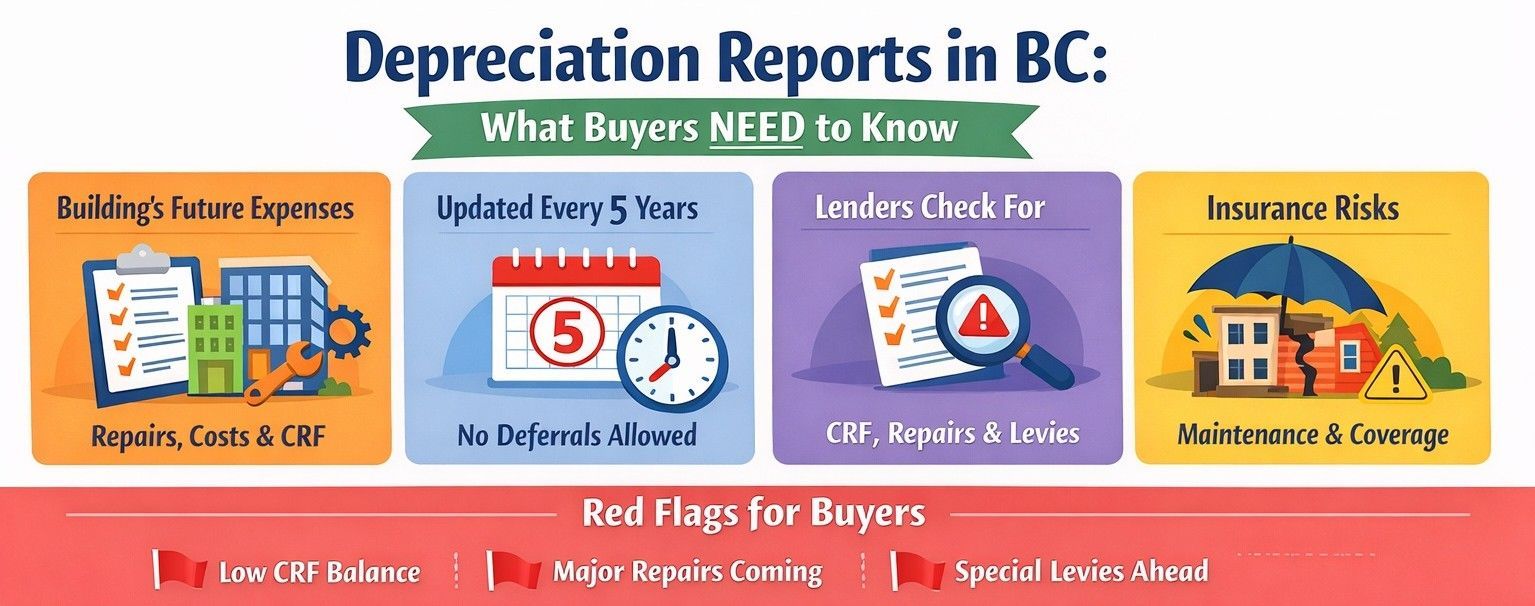
I usually explain it to clients like this: think of the depreciation report as the building’s “future expense roadmap.”
Why does this matter?
Because buildings age.
Eventually expensive things need fixing.
If the strata has planned ahead properly, repairs are usually easier to manage.
If they haven’t?
Owners can suddenly face large bills called
special levies.
That could mean:
- $5,000, $15,000, 30,000 or more
- The largest one I’ve had is a $90,000 special levy
That’s why lenders and insurance companies pay close attention to these reports – and you should too.
Which buildings need one?
In BC, most strata properties require a depreciation report.
Generally:
- 5 or more units → required
- condos, townhouses, bare-land strata → included
- 4 units or fewer → usually exempt
So if you’re buying in the Lower Mainland, this will almost always apply.
New Rules (2024–2027 Updates)
Recent regulatory updates have strengthened requirements across BC:
- Reports must be prepared by qualified professionals
- New strata developments must obtain their first report:
- Within 2 years after the first AGM (current rule)
- Within 18 months (for future developments)
- Developers must contribute up to $30,000 toward initial report costs
- 5-year cycle instead of 3-year / deferral system
These changes are designed to ensure better long-term planning and reduce the likelihood of surprise expenses for owners.
What is the Contingency Reserve Fund (CRF)?
The Contingency Reserve Fund — usually called the
CRF — is the strata’s savings account.
This money is used for:
- major repairs
- replacement projects
- emergency building costs
The depreciation report tells you: what repairs are coming.
The CRF tells you: whether money has been saved for those repairs.
If large repairs are coming and the CRF is low, that can become a problem. The money has to come from somewhere – and funds will be gathered via Special Assessments (Levies) to the homeowners.
What do lenders look for?
When banks and lenders review a condo purchase, they often review the building carefully too.
Here are common concerns:
1. How old is the report?
- Within 5 years → good timing wise, however will depend on the information in the report
- Older reports → may raise concerns
- No report → major red flag
2. Is enough money saved?
Lenders compare:
- money in the CRF
vs. - upcoming repair costs
Example: If the roof needs replacing soon but the CRF is low, lenders may get nervous.
3. Are major repairs coming?
Big-ticket items include:
- roof
- plumbing
- elevators
- balconies
- windows
- building envelope
These repairs can become very expensive in larger buildings.
4. Special levies
Lenders also review:
- past levies
- current levies
- planned levies
Frequent levies can sometimes signal financial stress in the building.
Insurance has become a much bigger issue
This has become a major concern in BC over the last few years.
If a building has:
- deferred maintenance
- aging systems
- poor financial planning
Insurance can become:
- expensive
- difficult to obtain
- or unavailable
And without proper insurance? Financing can completely fall apart.
What about buyers with less than 20% down?
If you’re putting down: 5%, 10% or 15% your mortgage needs Mortgage Default Insurance through: CMHC, Sagen or Canada Guaranty.
These insurers may review:
- the depreciation report
- Contingency Reserve Fund balance
- appraisal
- strata documents
- meeting minutes
If they feel the building is too risky, they can decline the application.
That’s why some condos:
- work fine with 20% down
- but may not work with 5% down
I see this most often with older buildings that have large repairs coming soon.
Final thoughts
Depreciation reports may not be exciting…
…but they are one of the most important documents when buying a condo or townhouse in BC.
They help you understand:
- what you’re really buying
- what future costs may look like
- whether financing could become difficult
- and whether the building appears financially healthy
Taking time to properly review these documents today could save you thousands of dollars — and a lot of stress — later.
Need help navigating your home buying & mortgage financing options? I’d be happy to guide you through what’s possible.
Kelly Hudson
Mortgage Broker
Mortgage Architects – A Better Way
Mobile: 604-312-5009
Kelly@KellyHudsonMortgages.com
www.KellyHudsonMortgages.com