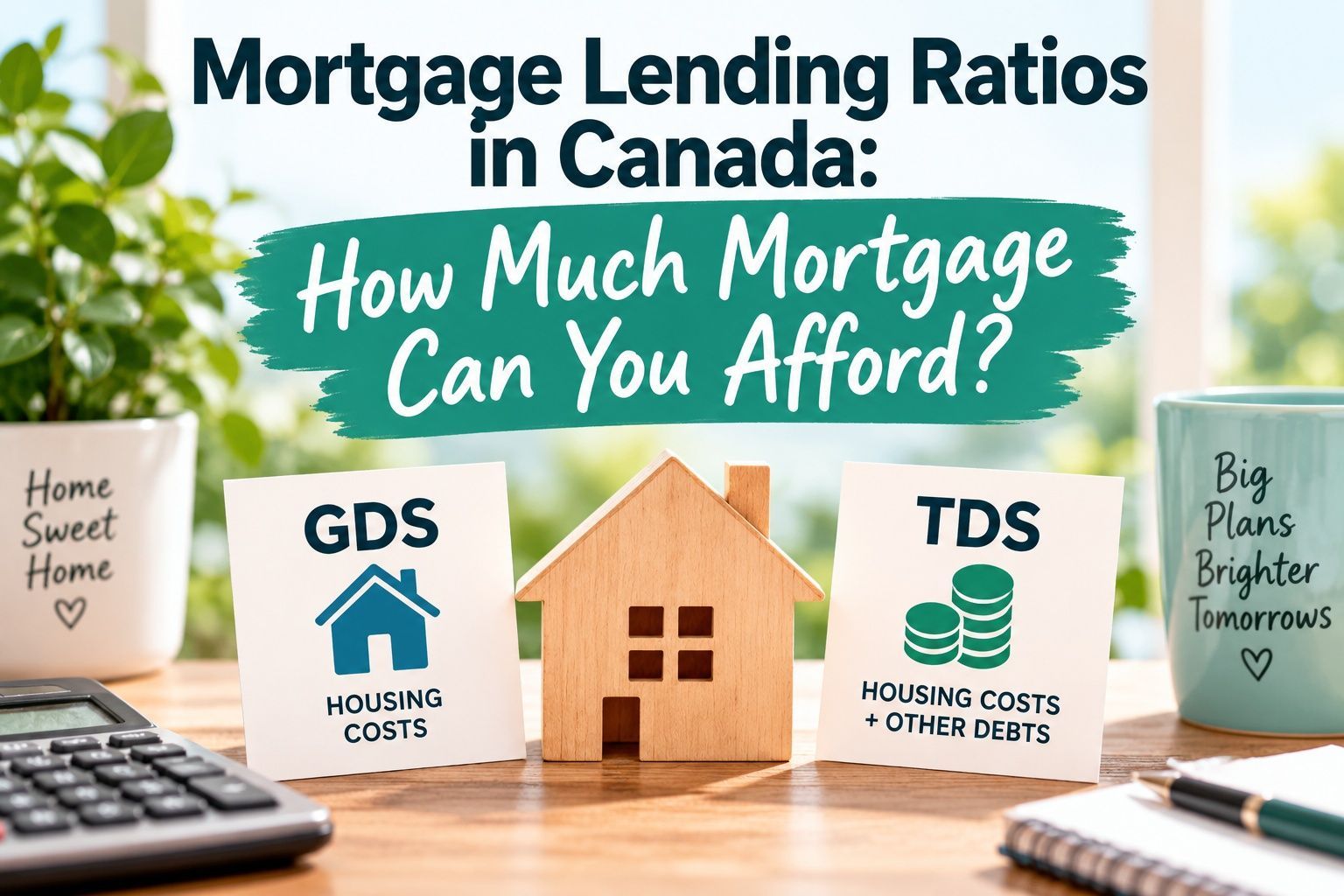
Mortgage Lending Ratios in Canada: How Much Mortgage Can You Afford?
If you're thinking about buying a home in BC, one of the first questions you probably have is:
How much mortgage can I qualify for?
Your income is certainly important, but it isn't the only number a mortgage lender looks at.
Lenders also consider your debts, credit history, down payment, property costs and something called your mortgage lending ratios.
The two ratios you'll hear about most often are GDS (Gross Debt Service) and TDS (Total Debt Service).
The names sound complicated. The math really isn't.
Understanding how GDS and TDS work can give you a much better idea of what you may qualify for — and why two people earning the same income could qualify for very different mortgage amounts.
What Are Mortgage Lending Ratios?
Mortgage lending ratios compare your monthly housing and debt expenses to your gross monthly income — your income before taxes and deductions.
There are two main ratios:
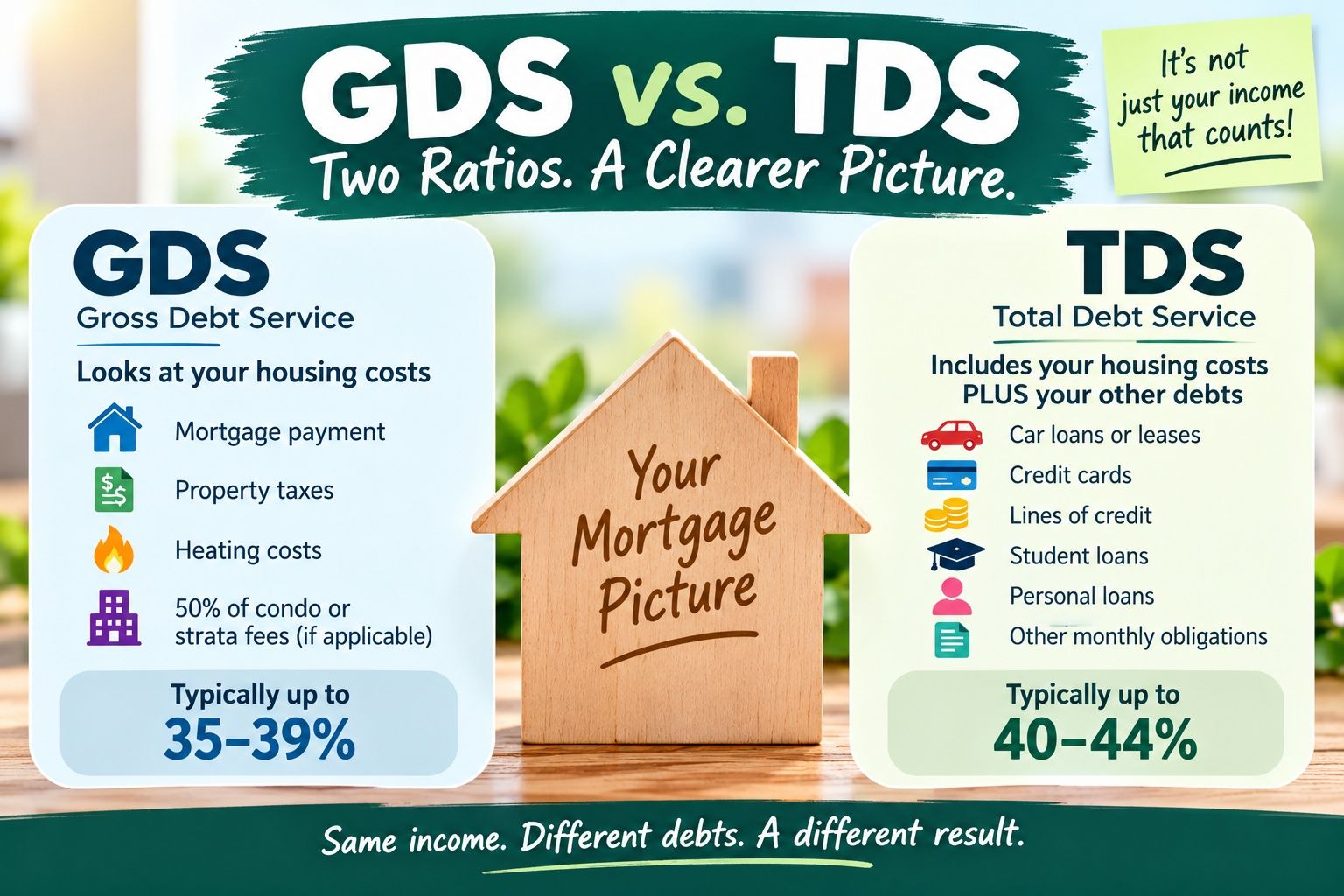
- Gross Debt Service (GDS) — How much of your income goes toward housing costs?
- Total Debt Service (TDS) — How much of your income goes toward housing costs PLUS your other debts?
Let's look at each one.
What Is the GDS Ratio?
Your Gross Debt Service (GDS) ratio looks at how much of your gross monthly income is required to cover the basic costs of owning your home.
When calculating GDS, lenders generally include:
- Your mortgage payment
- Property taxes
- Heating costs
- 50% of condo/strata fees (if applicable)
GDS Example
Let's say your household earns $10,000 per month before taxes.
Your monthly housing costs are:
- Mortgage payment: $2,800
- Property taxes: $400
- Heating: $150
- 50% of strata fees: $250
Total housing costs: $3,600 per month
To calculate your GDS: $3,600 ÷ $10,000 = 36% GDS
In simple terms, 36% of your gross monthly income is being used for housing costs.
What Is the TDS Ratio?
Your Total Debt Service (TDS) ratio goes one step further.
It includes the housing expenses used in your GDS calculation (see above) plus ALL your other monthly debt obligations.
These may include:
- Car loans or leases
- Credit card balances
- Lines of credit
- Student loans
- Personal loans
- Other monthly debt obligations i.e. child/spousal support
Let's continue with our example:
Your housing costs are $3,600 per month, but you also have:
- Car payment: $500
- Credit card & Line of Credit with a monthly balance of $10,000
- lenders calculate the payment at 3% of $10,000 = $300
Your total monthly obligations are now $4,400.
To calculate your TDS: $4,400 ÷ $10,000 = 44% TDS
That means 44% of your gross monthly income is being used for housing costs and other debt obligations.
What GDS and TDS Ratios Do Canadian Mortgage Lenders Allow?
This is where mortgage qualification gets a little more interesting.
For many traditional mortgage applications, you will commonly hear:
GDS: up to 35-39%
TDS: up to 40-44%
But don't assume that staying under those numbers automatically means you'll be approved.
Mortgage qualification isn't based on one calculation.
Different lenders and mortgage programs can have different guidelines. Your allowable ratios may also depend on your:
- Credit history and credit score
- Down payment
- Income and how it is earned
- Existing debts
- Type of property
- Mortgage product
- Overall strength of your application
This is one of the reasons I tell clients not to rely too heavily on a simple online mortgage calculator.
Your numbers need to be looked at as a complete picture.
Does Your Credit Score Affect How Much Mortgage You Can Qualify For?
Yes.
Your credit score and overall credit history are important parts of qualifying for a mortgage in Canada.
Canadian credit scores can range up to 900. Generally, a higher score indicates a stronger credit profile.
A credit score of around 680 or higher can be important for accessing certain mortgage qualification options, but lenders look at much more than the score itself.
They may also look at:
- Whether you make your payments on time
- How much debt you currently carry
- How much of your available credit you're using
- How long you've had established credit
- Recent applications for new credit
A great income doesn't necessarily make up for poor credit or high debt.
The good news? If there are issues with your credit, sometimes a little planning before you buy can make a big difference.
Don't Forget the Mortgage Stress Test
There's another important piece of the mortgage qualification puzzle: the mortgage stress test.
In many situations, you don't qualify using only the mortgage interest rate you'll actually be paying.
Instead, you may have to qualify using a higher interest rate – called the Stress Test.
- Currently the stress test is 5.25% OR whatever interest rate you are paying PLUS 2% (whichever is higher)
This is intended to demonstrate that you could continue to afford your mortgage if interest rates were 2% higher.
The important thing to understand is that your actual mortgage payment and your mortgage qualifying payment may be two different numbers.
And that can have a significant impact on how much mortgage you qualify for.
Qualifying for a Mortgage vs. Affording a Mortgage
This is one of the most important conversations I have with my clients.
Just because a lender says you qualify for a certain mortgage doesn't necessarily mean you should borrow that much.
You still need money for groceries, utilities, transportation, insurance, vacations, savings, home repairs — and life!
I want to know what monthly mortgage payment you are comfortable with, not simply the maximum payment a lender will approve.
Those can be two very different numbers.
Get Pre-Qualified Before You Start Shopping
If you're thinking about buying a home, getting pre-qualified before you start seriously shopping can help you understand:
- How much mortgage you may qualify for
- A realistic purchase price
- How your debts affect your borrowing power
- How much down payment you'll need
- What your estimated mortgage payment could look like
- Whether there are any credit or income issues we should address before you buy
It also gives us an opportunity to identify potential problems before you've fallen in love with a home.
My goal isn't simply to find out the biggest mortgage a lender will give you.
- It's to help you understand your options, find a mortgage that fits your plans and choose a monthly payment that makes sense for your life and your budget.
Because qualifying for a mortgage and comfortably affording a mortgage aren't always the same thing.
A little planning before you start shopping can make the entire home-buying process easier — and help you make a much more confident decision.
Need help navigating your home buying & mortgage financing options? Let’s have a chat
Kelly Hudson
Mortgage Broker
Mortgage Architects – A Better Way
Mobile: 604-312-5009
Kelly@KellyHudsonMortgages.com
www.KellyHudsonMortgages.com